The full case study involves institutional client data and is available on request. The short version: 70% reduction in operational overhead. $20M Series A with Apollo and Motive Partners. 0-to-1 platform now used to manage $600B+ in assets across global financial teams.
Three user types with different trust levels and different needs: fund administrators running day-to-day operations, investors moving through subscription workflows, and GPs who need visibility across their full book.
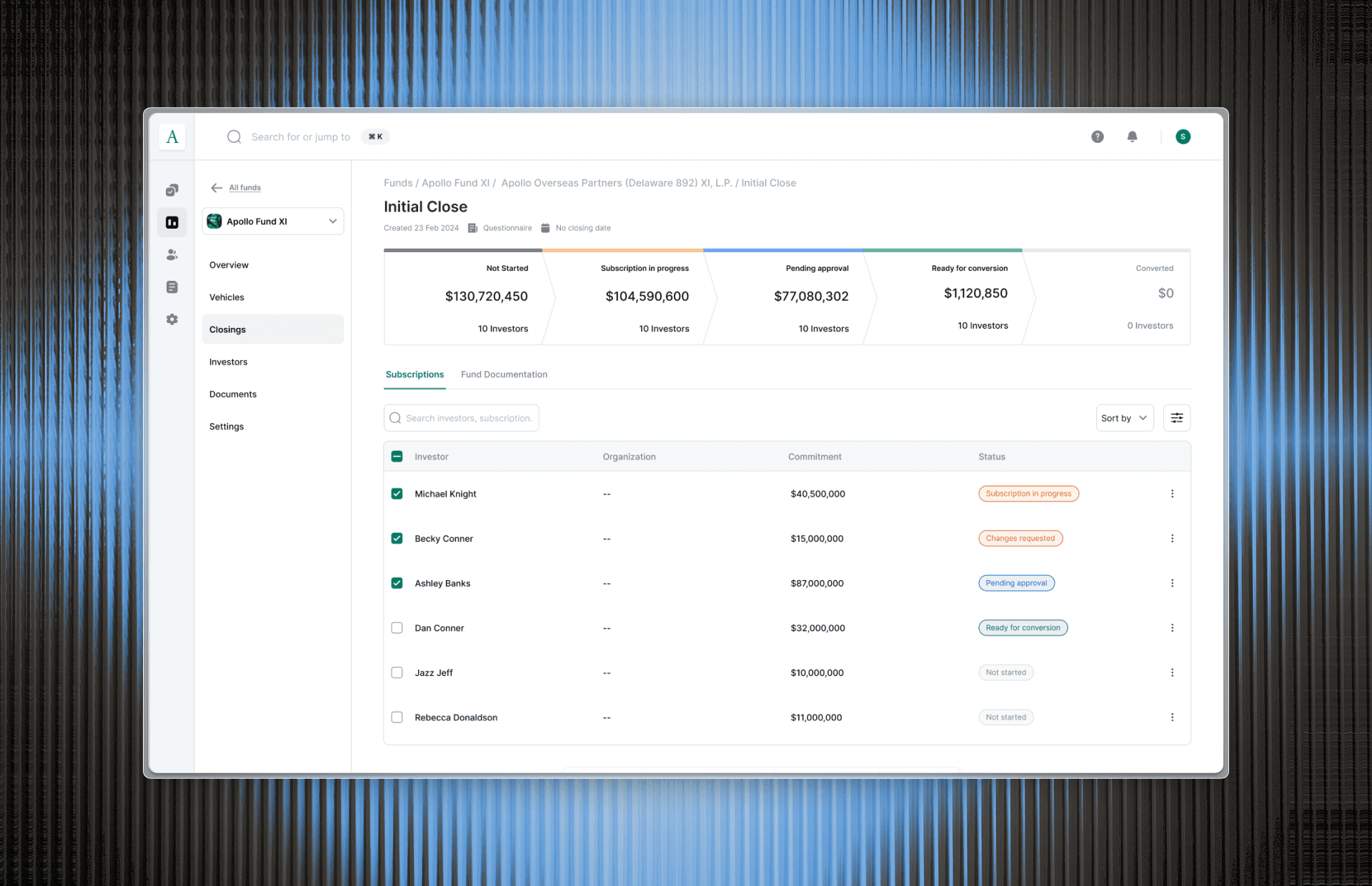
I designed the full product: investor-facing subscription workflows, internal ops dashboards, KYC and compliance pipelines, document management, and an investor workbench for managing LP relationships at scale. The platform handles the entire lifecycle of a capital raise, from initial investor onboarding through to close.
I had no background in alternative asset management when I joined. My users had 20-year careers in the domain. The first principle I set for myself: you earn nothing by making things complicated, and you earn everything by making the right thing obvious.
I spent the first two weeks embedded with the ops team before opening Figma. I read the actual legal documents investors were completing — subscription agreements, FATCA forms, KYC requirements. I built a glossary with the founding team so our language stayed consistent as the product grew. The hardest part wasn't the design. It was earning enough credibility with domain experts that they'd trust the product from the first round of feedback.
The platform went into production with Apollo as the first institutional client. They converted from a pilot to a five-year contract and led Vega's $20M Series A. 70% reduction in operational overhead for fund administrator teams.
The design work was cited directly in investor conversations during the raise, not as a product demo, but as evidence the company could build something institutional clients would trust.
This is enterprise software, not consumer mobile. The design questions here are different, trust is built through precision rather than delight, and expert users punish ambiguity faster than general users would. I'm including it as evidence of range and regulated domain knowledge, not as a direct parallel to consumer banking work. Full case study available on request at
earlyattoh@gmail.com